TL;DR
- Best overall for professional portrait workflows: Aftershoot. Portrait, Family Portraits, School Portraits, Boudoir, and Newborn culling options give photographers more control over how different types of people-focused sessions are assessed.
- Best for hands-on face comparison: Narrative. Its Close-ups Panel can display multiple detected faces side by side, while Eye and Focus Assessments help you make the final selection yourself.
- Best for transparent AI scoring: FilterPixel. It combines basic culling with DeepCull’s score-and-reason approach so you can see why an image was favored.
- Best for photographers already invested in AI editing: Imagen. Culling fits naturally into Imagen’s broader editing workflow, though its current pricing makes it less compelling as a standalone culling purchase.
- Best for skipping AI entirely: Photo Mechanic. No blur, eye, or duplicate detection of any kind, but it’s still the fastest manual browser available for photographers who trust their own eye over an algorithm.
- Best for bundling culling with high-volume retouching: Evoto. Culling flags the obvious rejects, then the same platform handles skin, background, and color work across hundreds of portraits at once.
- Best for staying inside Lightroom Classic: ON1 Lightpanel. Culling, face comparisons, and light retouching happen in your existing catalog, with no exporting or switching apps.
- Best for managing large, ongoing portrait archives: Excire Foto. Built more as a searchable photo library than a single-session culler, useful for studios with years of repeat client work to sort through.
- Don’t judge portrait culling tools on speed alone. The bigger question is how much time you’ll spend rechecking expressions, focus, duplicates, and group portraits after the AI finishes.
Portrait culling gets tricky for a reason that has very little to do with file count.
You might have eight nearly identical frames where the lighting, pose, and focus are all technically fine… but one person blinked in frame three, the smile looks more natural in frame five, and frame seven is the only one where everyone in the family is looking in the same direction.
That means the best AI culling tool for portrait photography needs to do way more than remove obvious blur and duplicates. It should help you compare faces, eye sharpness, expressions, and similar poses without taking the final creative decision away from you.
For most professional portrait workflows, Aftershoot is our strongest overall pick because it combines portrait-specific culling modes, closed-eye and key-face analysis, duplicate grouping, and an offline workflow with editing and retouching in the same platform. But it isn’t the automatic winner for everyone.
Narrative offers particularly strong face-by-face review tools, FilterPixel combines technical and genre-aware analysis, and Imagen makes the most sense if you’re already using its editing ecosystem. If you’d rather skip AI decision-making altogether, Photo Mechanic still browses large batches faster than anything else, just without any automated flagging. Evoto is worth a look if culling and heavy portrait retouching need to happen in the same place, ON1 Lightpanel suits anyone unwilling to leave Lightroom Classic, and Excire Foto is built less for culling a single shoot and more for finding your way back through years of a studio’s archived client work.
👁️ Also Read: Tips for Creative Portrait Photography
How we evaluated the best AI culling tools for portrait photography?
This isn’t a ranking based on which tool can blast through the most RAW files in the shortest benchmark.
For portrait photographers, a fast cull isn’t very useful if you spend another hour checking whether the AI chose the wrong expression.
We evaluated the tools around five portrait-specific questions:
- Can it help identify closed or soft eyes?
- Can you inspect individual faces in group portraits?
- How well does it organize near-identical poses or bursts?
- How much control do you retain over the final selects?
- What happens after the cull? Can those selects move smoothly into editing, retouching, or delivery?
We also checked current product documentation and pricing rather than relying on older comparison articles. That’s particularly important in this category: Lightroom’s culling capabilities changed significantly in 2026, while Imagen and FilterPixel have both updated their pricing and product structures.
👁️ Also Read: How to Shoot Conceptual Portrait Photos?
At a glance: 5 best AI culling tools for portrait photography
| Tool | Best for | Face and eye analysis | Similar-shot review | Processing | Culling price |
| Aftershoot | Portrait studios wanting culling connected to editing and retouching | Key Faces, Image Scores, closed-eye and focus analysis | Automatic duplicate grouping and Survey Mode | Local/offline | $10/mo billed annually |
| Narrative | Photographers who want AI assistance while making selections manually | Eye & Focus Assessments, Smart Face Zoom, Close-ups Panel | Scenes View and image comparison tools | Desktop app | From $10/mo annually; advanced culling from $20/mo |
| Adobe Lightroom Classic | Photographers who want culling inside their existing catalog | Per-face Eye Sharpness and Eyes Open scores | Auto Stack based on time and visual similarity | Lightroom desktop workflow | Included with eligible Lightroom subscription |
| FilterPixel | Photographers who want explainable AI scoring | Blink, expression, focus, and technical analysis | Similar-image comparison plus AI selection | Cloud-based processing through desktop workflow | From $14.99/mo annually |
| Imagen | Existing Imagen editing users | AI-assisted selection and technical filtering | Culling integrated with Imagen workflow | Cloud-assisted | From $29/mo as PAYG culling add-on; included in Limitless |
Note: Pricing and product information checked against vendor documentation in August 2026. Plans and features can change, so verify current pricing before subscribing.
5 Best AI Culling Tools For Portrait Photography
1. Aftershoot: Best overall AI culling tool for portrait photography
Aftershoot features and functionality
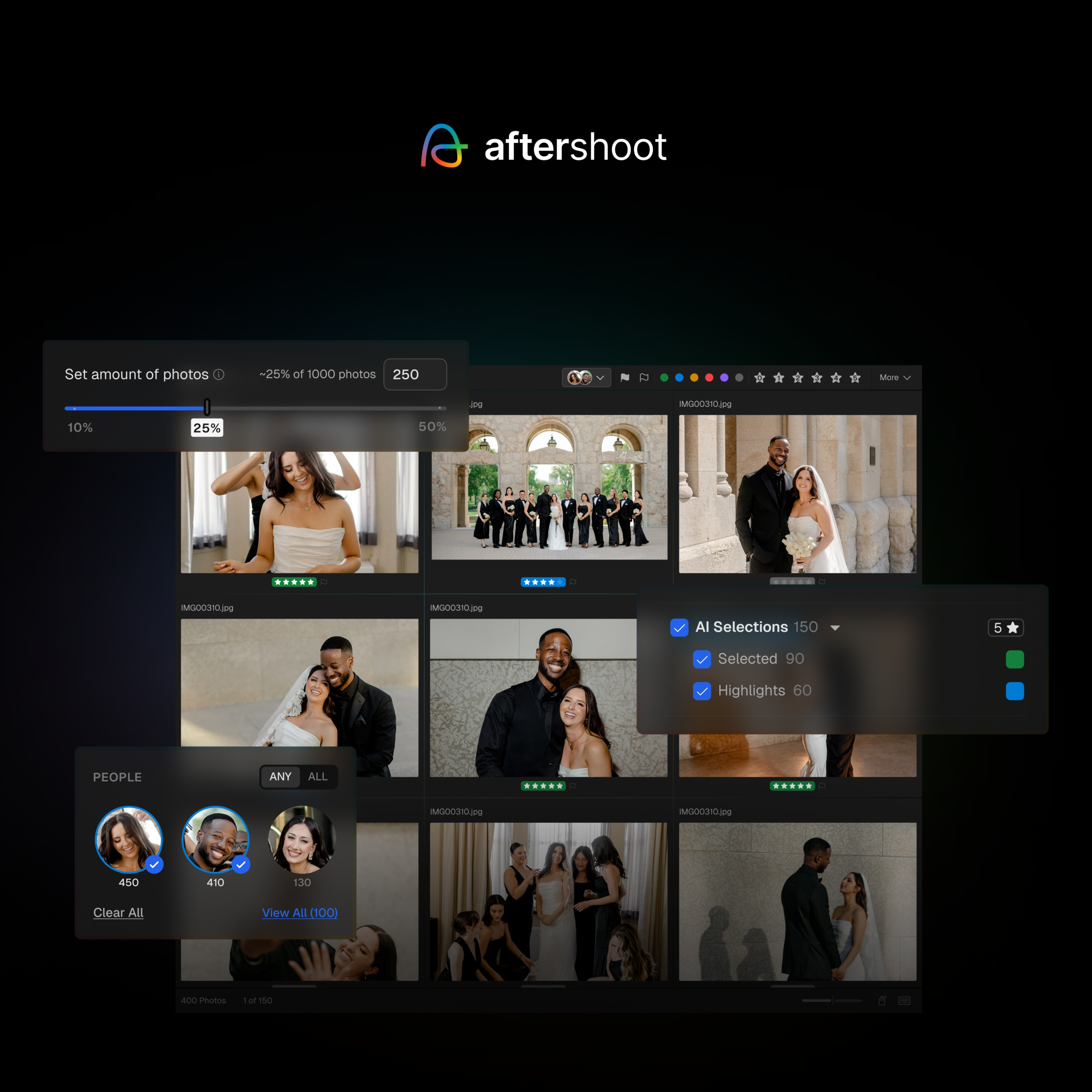
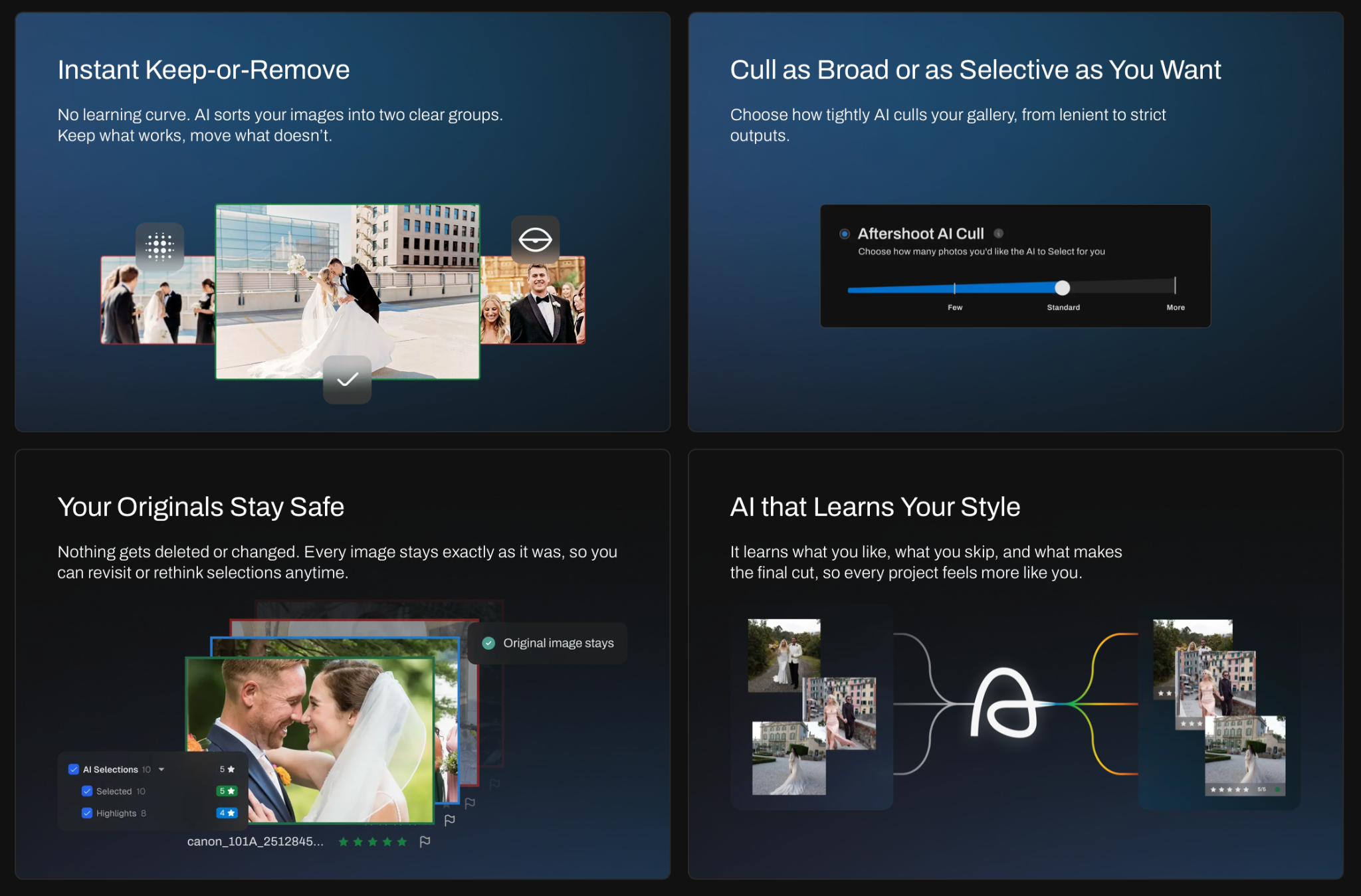
Aftershoot Select gives photographers two ways to cull: Automated AI Culling, where the software recommends selections based on your preferences, and AI-Assisted Culling, where you make the selections while AI helps organize the shoot.
For portrait photographers, the bigger advantage is that the cull can be adjusted for the type of session you’re shooting.
Aftershoot currently includes dedicated culling genres for:
- Portraits & Headshots
- Family Portraits
- School Portraits
- Boudoir
- Newborn
- Weddings & Engagements
- Other photography genres
Those modes don’t all assess photographs in exactly the same way, and that makes a huge difference for photographers… let me explain how.
For example, Aftershoot’s Portrait & Headshots mode looks for factors including blur, emotion, closed eyes, and similar poses. Family Portraits is intended for controlled images containing multiple important people, while Newborn and Boudoir workflows allow photographers to account for situations where closed eyes may be intentional rather than a reject.
That’s a useful distinction. The correct expression for a corporate headshot isn’t necessarily the correct expression for a newborn portrait.
During review, Key Faces gives you enlarged views of detected faces, while Image Scores can show assessments based on factors including focus and closed eyes. Similar photographs can also be grouped automatically and compared side by side in Survey Mode.
If you’d rather understand the complete process before choosing software, our AI photo culling workflow guide walks through the workflow from import to final review.
👁️ Also Read: How to Cull Photos Quickly with Aftershoot
What happens after the cull
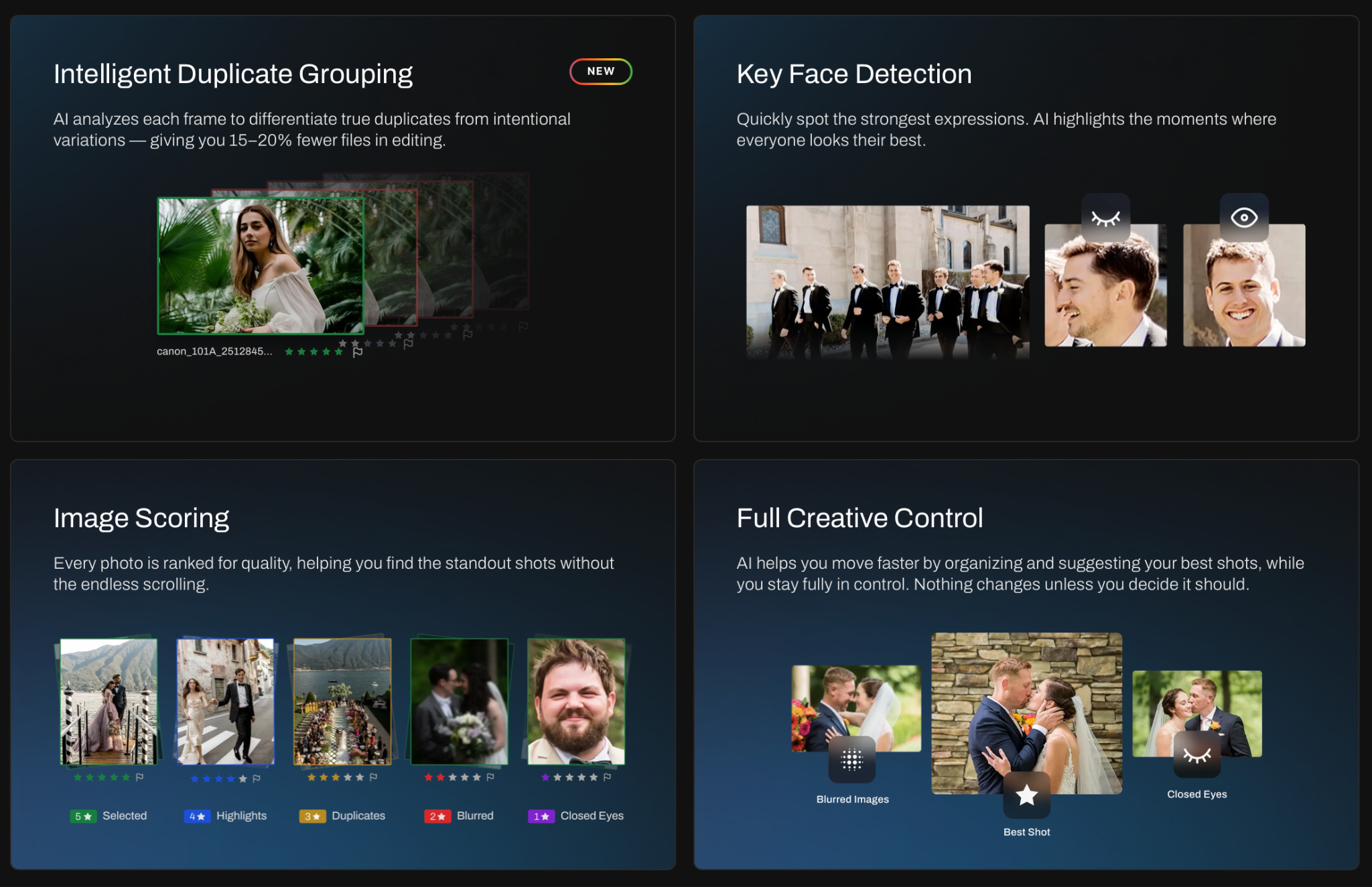
Aftershoot also connects culling with AI editing and AI retouching.
So instead of thinking only about how quickly you can identify selects, consider how many handoffs happen afterward.
A portrait studio might otherwise:
- Cull in one application.
- Export ratings.
- Open the selects in Lightroom.
- Apply base edits.
- Move hero images into another retouching tool.
- Export again for delivery.
Keeping more of those stages together doesn’t make the creative decisions disappear. It reduces the repetitive moving, sorting, and re-importing around them.
Aftershoot privacy and platform support
Aftershoot runs on macOS and Windows and can process images locally. Your original photographs don’t need to be uploaded to the cloud for culling.
That can be especially relevant to photographers working with private portrait sessions, schools, families, newborns, or boudoir clients.
After the cull, ratings and color labels can be moved into workflows involving Lightroom Classic or Capture One.
Aftershoot pricing
| Plan | Annual billing | Monthly billing |
| Select | $10/mo | $15/mo |
| Edit | $30/mo | $35/mo |
| Retouch | $20/mo | $25/mo |
| Complete | $45/mo | $55/mo |
The Complete plan includes Select, Edit, and Retouch and is $45/month when billed annually.
Aftershoot uses flat-rate pricing rather than charging per processed image.
Advantages of Aftershoot
- Dedicated culling options for several portrait genres
- Closed-eye, focus, Key Faces, and duplicate analysis
- Automated and AI-assisted approaches depending on how much control you want
- Local processing on macOS and Windows
- Unlimited image processing under the current flat-rate plans
- Culling connects directly with editing and retouching
- Survey Mode makes comparing near-identical photographs easier
Limitations of Aftershoot
- Local AI processing means performance can vary with your computer’s hardware
- Automated selections still need a final human review, especially when expression is intentionally unconventional
- Photographers who only want a lightweight manual culling interface may not need the broader post-production platform
Who should choose Aftershoot?
Aftershoot makes the most sense for portrait, family, school, headshot, boudoir, and newborn photographers who shoot enough volume for duplicate review and first-pass selection to become a real workflow bottleneck.
It’s particularly useful if culling is only one part of the problem and you also want to reduce the number of tools used between ingest and final retouching.
Got more questions? Take a look at our Culling FAQs.
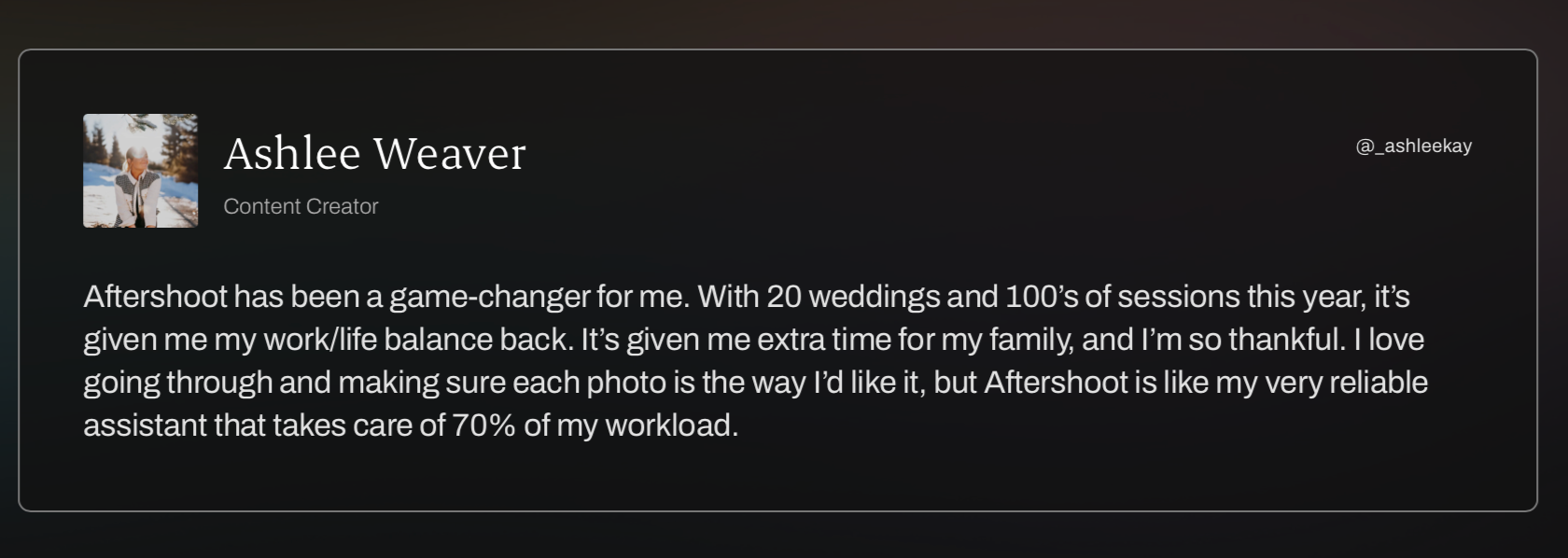
You don’t have to take our word for it when we say Aftershoot is one of the best AI culling tools for portrait photography… hear it from Ashlee Weaver:
2. Narrative: Good for hands-on face and expression review
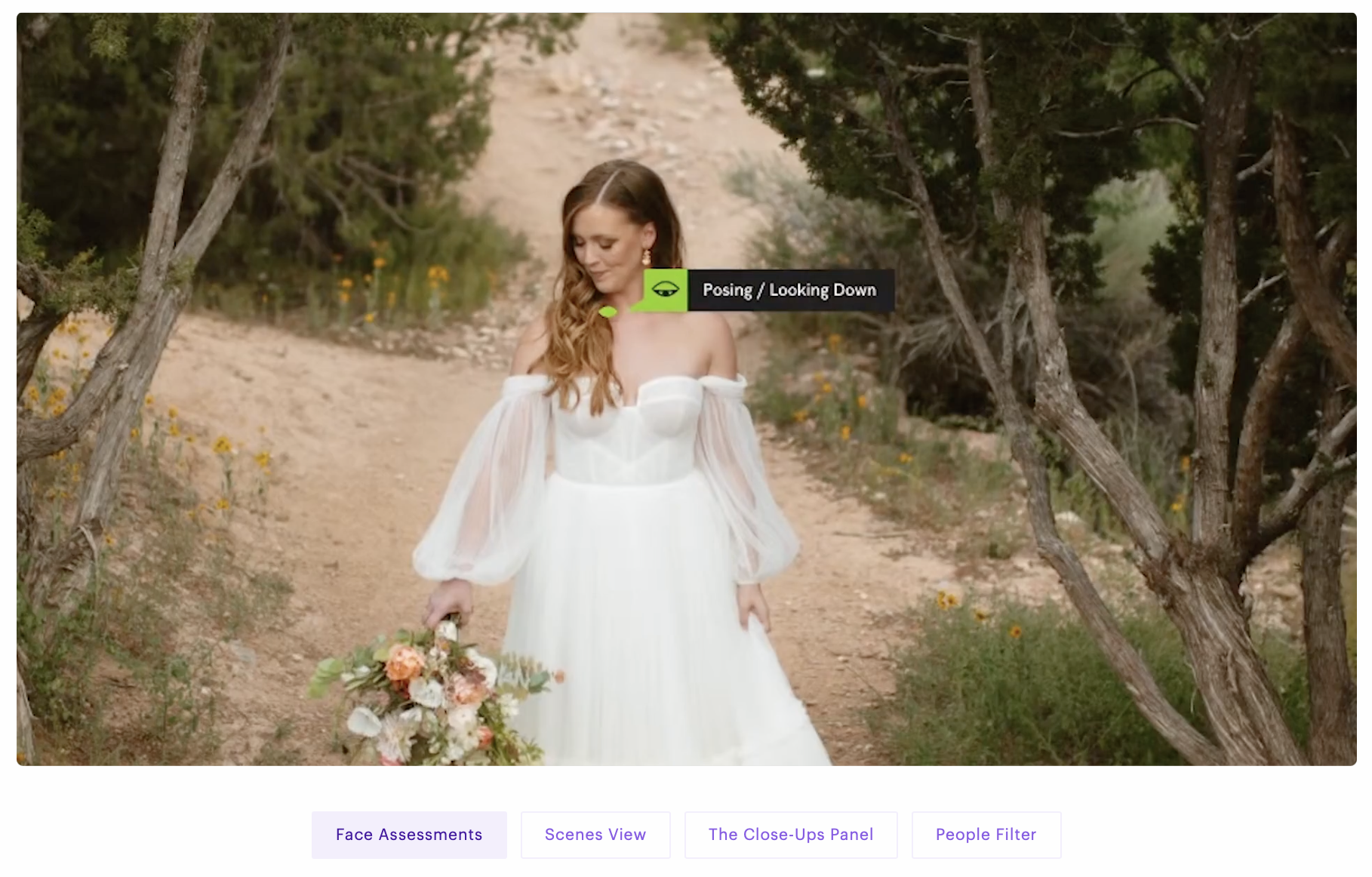
Narrative features and functionality
Narrative takes a slightly different approach.
Rather than simply asking you to trust a final list of AI picks, many of its strongest culling features are designed to make your own review faster.
The standout for portraits is the Close-ups Panel. Narrative says it can display up to 24 detected faces simultaneously, letting you compare expressions without repeatedly zooming in and out of a large group portrait.
That becomes useful very quickly when you’re looking at:
- Large family photographs
- Wedding party portraits
- School groups
- Team photographs
- Corporate group headshots
Narrative also provides Eye and Focus Assessments, Smart Face Zoom, image focus scores, and Scenes View on its advanced culling tiers.
Scenes View groups related photographs and ranks images within each scene using Narrative’s assessments. Instead of moving through a session strictly one file at a time, you can review photographs in context.
Narrative’s current website offers the software for both Windows and macOS, so Windows support should not be used as a reason to eliminate it from a 2026 comparison.
Narrative pricing
When billed annually, current plans start at:
| Plan | Price | Relevant culling capability |
| Lite | $10/mo | Basic culling, unlimited projects and images |
| Standard | $20/mo | Advanced AI culling, Close-ups Panel, Scenes View |
| Premium | $40/mo | Standard + personal AI editing presets |
| Ultra | $60/mo | More personal AI presets and multi-user features |
The distinction matters for this comparison: the $10 Lite plan does not include the full set of advanced portrait review features.
If the Close-ups Panel or Scenes View is why you’re considering Narrative, Standard is the more relevant starting point.
Advantages of Narrative
- Excellent interface for inspecting several faces at once
- Close-ups Panel is particularly useful for group portraits
- Strong focus and eye-assessment tools
- Leaves photographers closely involved in final selection decisions
- Available on Windows and macOS
- Unlimited images and projects on current plans
Limitations of Narrative
- The most useful advanced culling features start on the $20 Standard tier, not Lite
- Photographers wanting highly automated final selections may prefer a more automation-led workflow
- Retouching and client delivery aren’t the focus of the platform
Who should choose Narrative?
Narrative is a strong choice if you don’t want AI to make too many creative decisions for you but you do want it to remove the tedious mechanics of checking focus and expressions.
For group-heavy portrait photographers, the face-comparison workflow is particularly compelling.
3. Photo Mechanic
Photo Mechanic Features and Functionality
Photo Mechanic isn’t an AI culling tool, and it’s worth saying that plainly upfront. It’s a photo browser built for speed: it renders the embedded JPEG preview inside a RAW file instead of processing the RAW data itself, which is why photographers have relied on it for two decades to open a folder of 5,000 images without the lag that Lightroom or Bridge introduce at that volume.
Everything else is manual. There’s no eyes-closed detection, no blur scoring, no duplicate grouping, and no expression analysis. You’re tagging color labels and star ratings by eye, at speed, using keyboard shortcuts. For portrait work specifically, that means checking every face in a group shot yourself, frame by frame, with none of the per-face flagging that Aftershoot or Narrative Select provide.
Where it still earns a place in some studios’ workflows is metadata and ingest: fast batch renaming, keywording, captioning, and copyright stamping on import, which several AI culling tools (Aftershoot, FilterPixel) support as an export destination rather than replace outright.
Photo Mechanic Pricing
Photo Mechanic is sold two ways. Perpetual licenses are one-time purchases: Photo Mechanic 6 at $139, or Photo Mechanic Plus (with added asset-management features) at $249. Perpetual licenses get a year of updates and support, then keep working on the last compatible OS version without further updates. Subscription licenses run $14.99/month or $149/year, with continuous updates and support for as long as the subscription stays active. A free 30-day trial is available with no payment method required.
Advantages of Photo Mechanic
- Fastest RAW preview rendering of any tool in this comparison, even on large batches
- One-time perpetual license option, unlike the subscription-only AI tools here
- Strong metadata, keywording, and captioning tools built for photojournalism and event delivery
- Two decades of refinement behind its keyboard-shortcut workflow
Limitations of Photo Mechanic
- No AI culling of any kind: no eyes-closed detection, no blur scoring, no duplicate grouping, no expression analysis
- Every selection decision is fully manual, which is slower than AI-assisted tools for portrait-heavy, face-first culling
- Interface hasn’t meaningfully modernized, and reviewers on Capterra note it can feel dated next to newer tools
- No group-shot consistency scoring, which matters more in portrait and family work than in the photojournalism use case it was built for
Who Photo Mechanic Is Best Suited For
Photojournalists, sports photographers, and photographers who want a one-time purchase over a subscription, and who are comfortable culling portraits by eye rather than letting AI flag closed eyes and expression issues first.
4. FilterPixel: Best for transparent AI recommendations
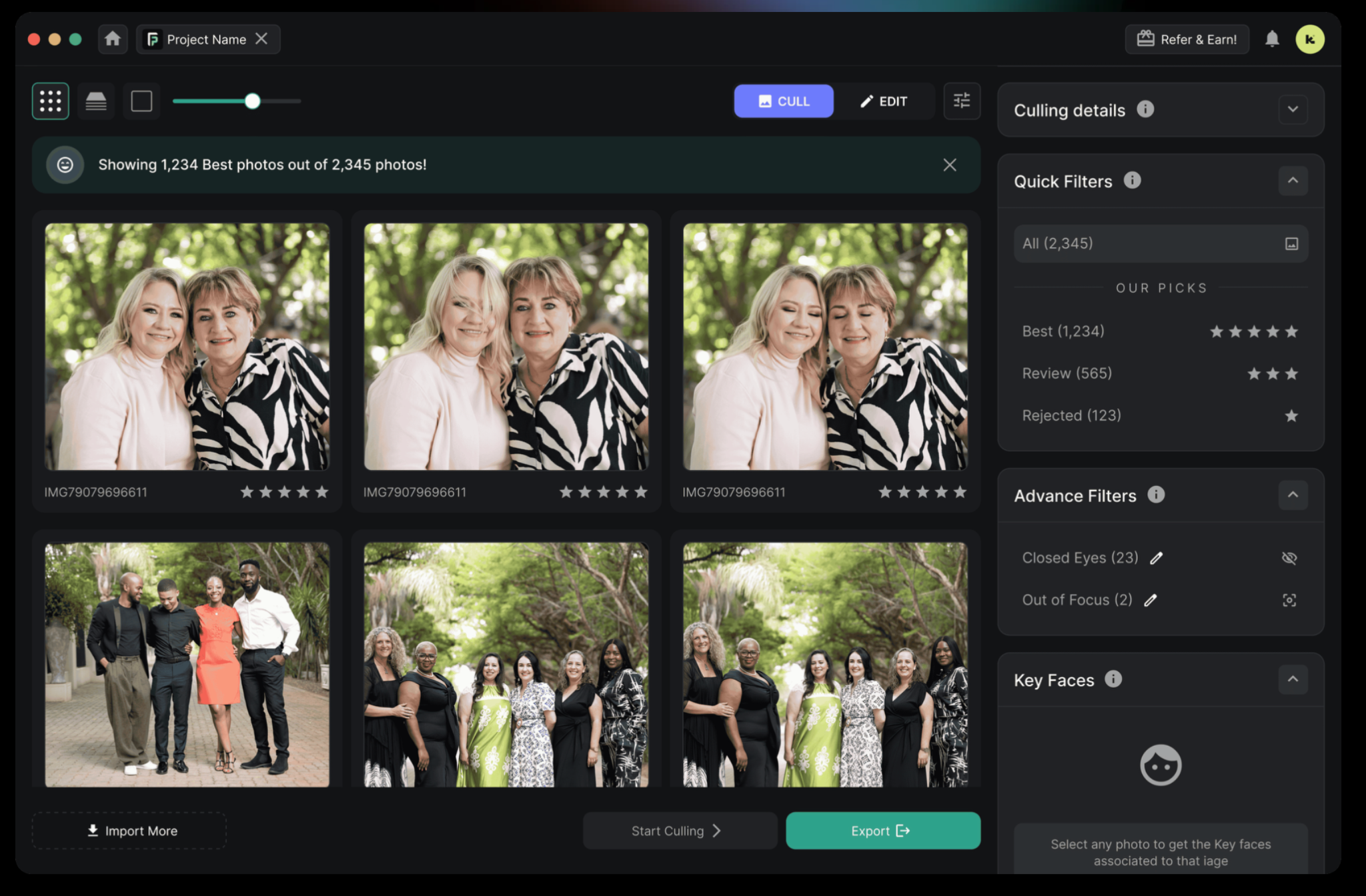
FilterPixel features and functionality
FilterPixel separates its culling workflow into two broad approaches.
Basic Culling handles technical checks including:
- Blur
- Focus
- Closed eyes
- Expressions
- Similar photographs
DeepCull goes further by scoring photographs against several criteria and providing a written reason for its decision.
Current DeepCull output can evaluate factors such as:
- Subject lighting
- Background cleanliness
- Narrative clarity
- Moment timing
- Technical quality
That explainability is its most interesting differentiator.
Instead of simply seeing that the AI prefers frame 47 over frame 48, you can inspect why it made that choice and decide whether its reasoning makes sense for the portrait you’re delivering.
FilterPixel’s current product pages also market genre-aware culling for portrait work alongside weddings, events, sports, and other photography categories.
FilterPixel processing
FilterPixel currently uses cloud processing while providing desktop workflows for Mac and Windows.
That means it can move heavier processing away from your computer, but photographers working with privacy-sensitive portrait sessions should factor cloud processing into their decision.
FilterPixel pricing
FilterPixel currently gives new users four trial projects, rather than the permanent four-project free tier described in some older comparisons.
Its paid pricing is:
| Plan | Annual billing equivalent | DeepCull allowance on annual plan |
| Standard | $14.99/mo | 20 shoots/year |
| Pro | $34.99/mo | 70 shoots/year |
| Studio | $64.99/mo | 140 shoots/year |
Additional DeepCull shoots are currently listed at $7.99 each.
Basic culling is unlimited on paid plans, while DeepCull allowances depend on the tier.
Advantages of FilterPixel
- AI recommendations include scores and explanations
- Basic culling covers common portrait issues such as blur, focus, and blinks
- Cloud processing reduces reliance on local hardware
- Lightroom and Capture One workflows are supported
- Trial projects let you test the software against your own portrait sessions
Limitations of FilterPixel
- DeepCull usage is capped by plan tier
- Cloud processing may not suit every privacy workflow
- Current FilterPixel documentation describes its genre options differently across some pages, so photographers relying on a specific portrait mode should verify its availability in the current app before choosing a plan
Who should choose FilterPixel?
FilterPixel is worth considering if you want to understand the reasoning behind AI picks rather than seeing an unexplained selection.
It’s also useful for photographers whose work spans portraits and faster-turnaround genres such as events or sports.
5. Imagen: Best for photographers already using Imagen to edit
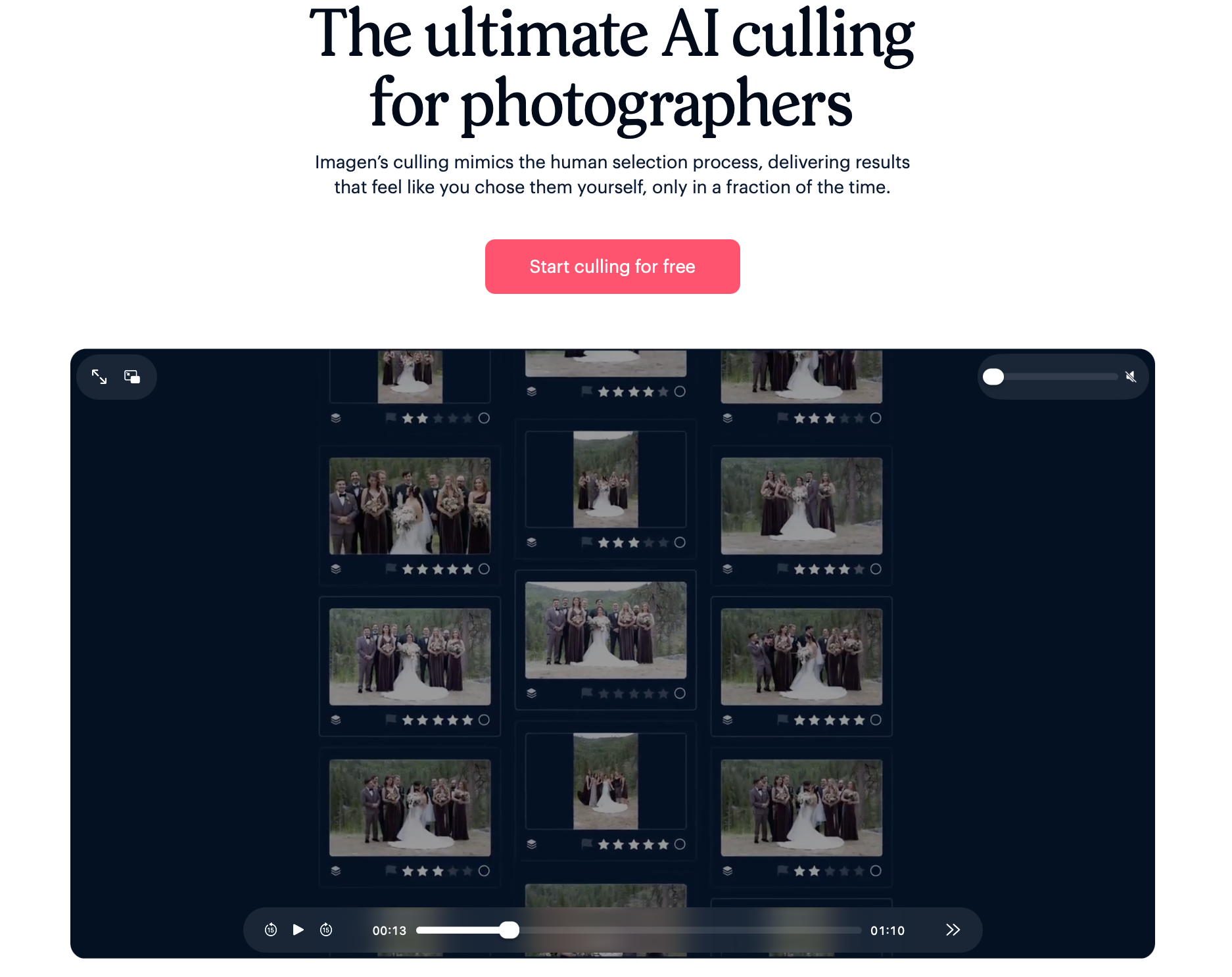
Imagen features and functionality
Imagen is best known for AI-assisted editing, but culling can sit at the start of the same post-production workflow.
That makes its strongest argument less about being a standalone portrait culling application and more about what happens after you’ve made the selection.
If you already rely on Imagen for editing, keeping the cull inside the same ecosystem can reduce another handoff.
Its culling tools can help narrow a shoot before you move into editing, while Imagen’s editing profiles handle bulk color and tonal adjustments afterward.
Imagen pricing
Imagen’s public pricing lists:
- Pay-As-You-Go editing: $0.05 per edit at the retail rate, with discounted annual-volume plans available
- Culling for PAYG users: from $29/month as a separate subscription
- Limitless: $179/month billed annually, including unlimited editing, AI tools, retouching, and AI culling
- Business: custom pricing for multi-photographer studios
Imagen also offers 18K, 36K, and 72K annual editing-volume plans with discounted per-edit pricing.
That makes the economics quite different from Aftershoot or Narrative.
Advantages of Imagen
- Culling can feed directly into an established Imagen editing workflow
- Strong option for photographers already using Personal AI Profiles
- PAYG editing can suit photographers whose volume varies considerably
- Limitless now bundles culling with editing and AI tools
Limitations of Imagen
- The current standalone culling entry price is substantially higher than older comparisons suggest
- PAYG editing adds a variable cost based on the number of photographs processed
- Portrait photographers primarily shopping for culling may get more specialized review tools elsewhere
- Limitless is priced for photographers making broader use of Imagen, not someone who only needs a culling utility
Who should choose Imagen?
Imagen makes the most sense if you already use, or plan to use Imagen for AI editing.
If culling is the only problem you’re trying to solve, compare its $29/month culling option against dedicated alternatives before committing.
6. Evoto
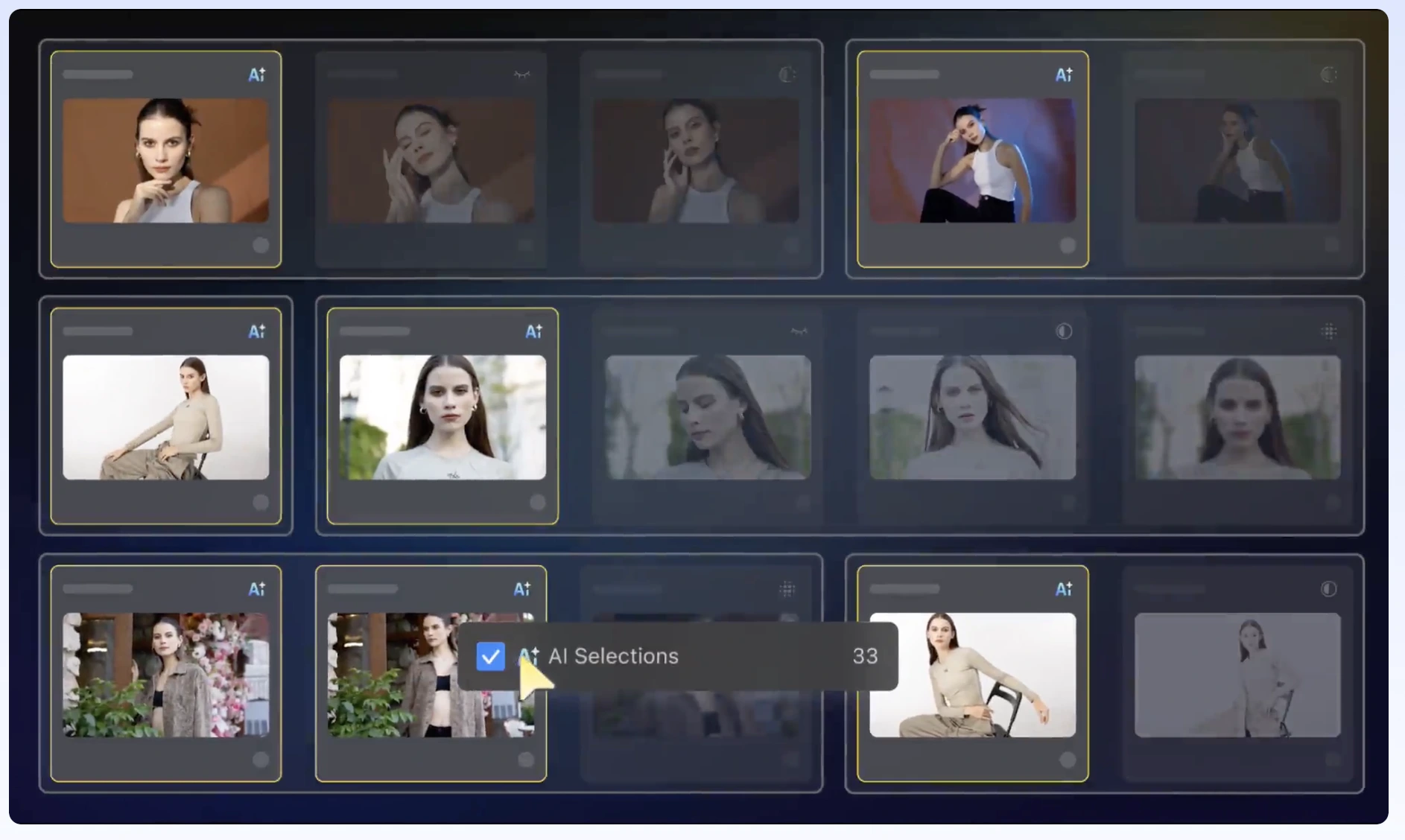
Evoto Features and Functionality
Evoto pairs AI culling with what it’s actually known for: fast, high-volume portrait retouching. Its AI Culling feature (launched fall 2025) flags blur, poor exposure, and closed eyes, then groups similar frames so you can pick the best from each burst, comparable in concept to Aftershoot’s first pass, though newer and less refined specifically for group-shot consistency.
Where Evoto pulls ahead is what happens after culling. It applies skin smoothing, background replacement, spill removal, and AI Color Match across hundreds of images at once, which is why it’s become popular with school photographers and studios doing headshot sessions at volume. Editing and previewing are free inside the app; exporting a finished image is what costs you.
Evoto Pricing
Evoto runs on a credit system rather than flat monthly fees. Every exported image consumes one credit; editing and previewing don’t cost anything. Annual subscription plans start around $6.99 per credit at the smallest tier (800 credits/year), scaling down per-credit as volume increases, with unused credits rolling over while the subscription stays active. Pay-as-you-go credit packs are also available, valid for two years from purchase. A 7-day free trial is offered.
Advantages of Evoto
- Culling and high-volume retouching live in one app, which cuts a step for portrait and school photographers
- AI Color Match and background tools are genuinely strong for studio and headshot work
- Free editing and previewing means you only pay for images you actually deliver
Disadvantages of Evoto
- Credit-based pricing makes monthly cost harder to predict than flat-fee tools like Aftershoot or Narrative Select
- AI Culling is newer and less refined for face-specific, group-shot scoring than dedicated culling tools
- Cloud-based, so client images leave your machine during processing
Who Evoto Is Best Suited For
School, headshot, and portrait studios that need heavy retouching volume alongside culling, and who are comfortable with credit-based pricing tied to export count rather than a flat subscription.
7. ON1 Lightpanel
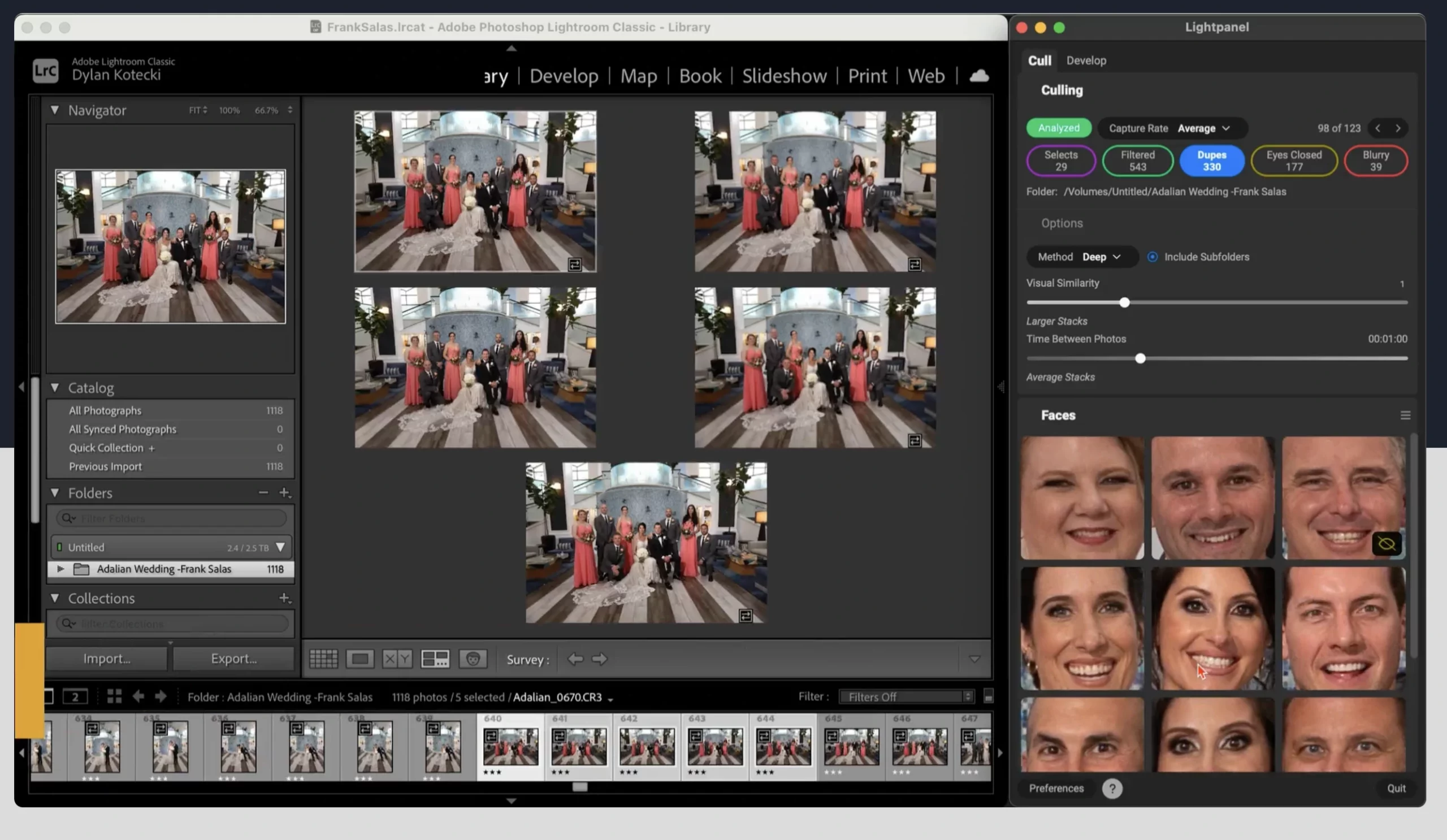
ON1 Lightpanel Features and Functionality
Lightpanel is the only tool in this comparison that runs as a plugin directly inside Lightroom Classic rather than as a separate app. It groups similar photos, flags blur and closed eyes, and adds zoomed-in face comparisons for checking expressions across a burst — built with wedding and portrait photographers specifically in mind, since that’s the workflow ON1 designed it around.
Because there’s no import or export step, ratings and edits stay in your existing catalog the entire time. It also includes AI-driven tone and color adjustments, plus real-time sliders for skin smoothing and eye enhancement, all inside the same panel.
ON1 Lightpanel Pricing
Lightpanel is sold as an annual subscription at $299.99/year, though early adopter and promotional pricing has brought it down to around $199.99/year. Pricing and promotions are worth confirming directly on ON1’s site, since introductory offers have shifted since launch.
Advantages of ON1 Lightpanel
- Native Lightroom Classic integration means zero app-switching or re-importing
- Zoomed-in face comparison tools built specifically for portrait and wedding expression-checking
- Real-time retouching sliders (skin smoothing, eye enhancement) available inside the same panel as culling
Disadvantages of ON1 Lightpanel
- Requires an existing Lightroom Classic subscription to use at all, adding to total software cost
- Priced higher annually than most standalone culling tools once you factor in the Lightroom subscription underneath it
- Newer to market than Aftershoot or Narrative Select, with a thinner track record of reviews — it currently shows no reviews yet on G2
Who ON1 Lightpanel Is Best Suited For
Portrait and wedding photographers who are committed to Lightroom Classic as their primary catalog and want AI culling and light retouching without ever leaving it.
8. Excire Foto
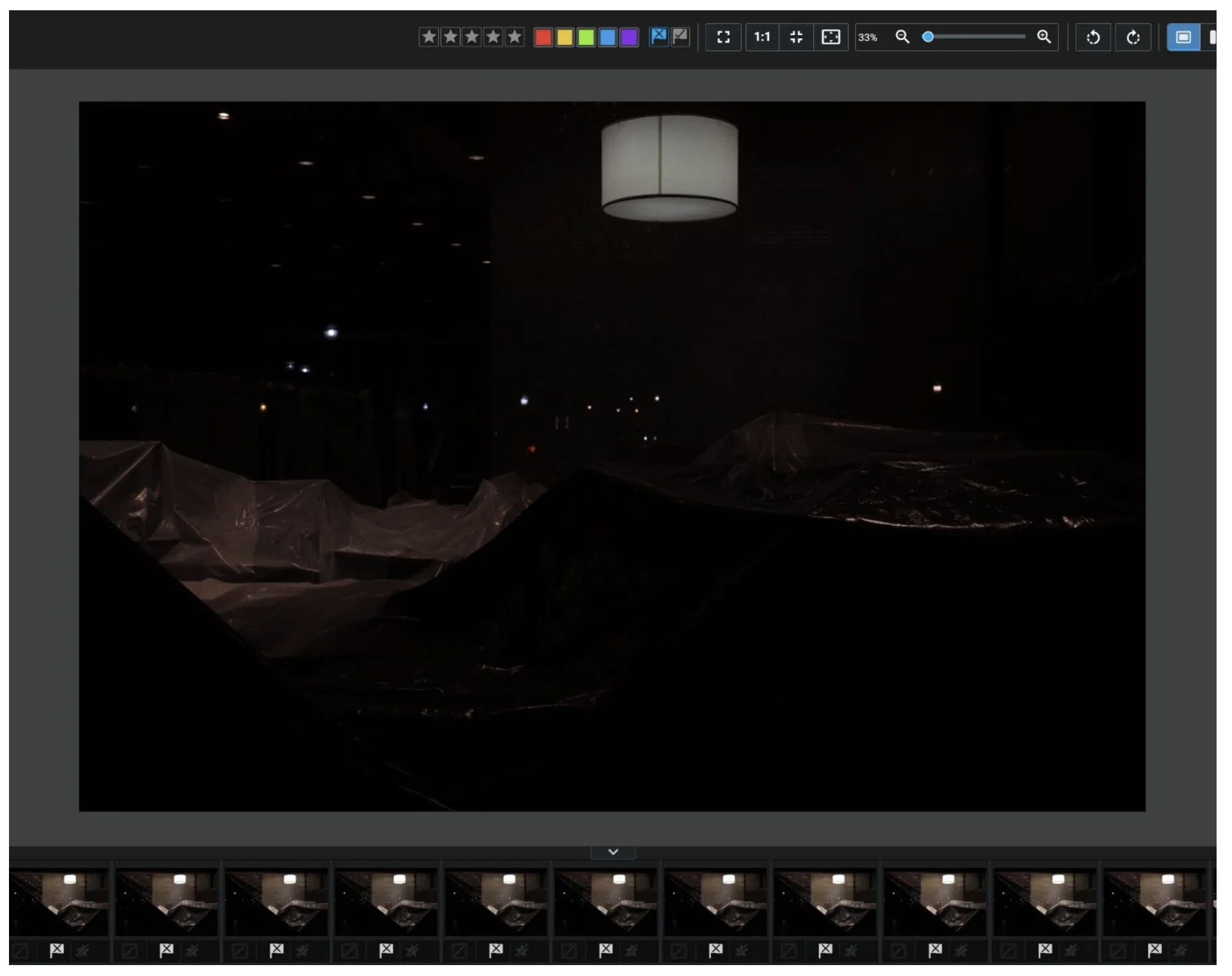
Excire Foto Features and Functionality
Excire Foto is built as an AI photo organizer first and a culling tool second, which sets it apart from everything else on this list. Its strength is searching and managing a large, ongoing photo library — free-text search (“bride laughing, eyes open, outside”), face recognition with named people collections, and duplicate detection across years of archived sessions, not just a single shoot.
Its newest version added a dedicated Survey Mode for culling, along with sharpness markers and face-based filters for eyes-open status, bringing it closer to a real culling workflow than earlier versions. It runs entirely locally on Windows or Mac, with no cloud upload.
For a portrait studio, Excire is less about culling a single family session the day after the shoot, and more about being able to find every portrait of a specific returning client across ten years of archives in seconds.
Excire Foto Pricing
Excire Foto is a one-time purchase, not a subscription: the current version runs $249 (with regular promotional pricing bringing it to around $219). Upgrades from earlier versions are discounted for existing owners. A 14-day free trial is available with no payment information required.
Advantages of Excire Foto
- One-time purchase with no ongoing subscription, unlike every other tool in this comparison
- Best-in-class free-text and face search across large, multi-year archives
- Fully local processing, with no cloud upload at any point
- Genuinely useful for studios managing repeat portrait clients over years, not just single sessions
Disadvantages of Excire Foto
- Built primarily as a photo organizer, so its shoot-by-shoot culling is less purpose-built than Aftershoot’s or Narrative Select’s
- No dedicated group-shot consistency scoring for family or team portraits
- No built-in editing or retouching, so it needs to sit alongside another tool for that step
Who Excire Foto Is Best Suited For
Portrait studios managing large, ongoing client libraries who need to search and retrieve past sessions as much as cull new ones, and who want to avoid another monthly subscription.
AI culling tool pricing comparison for portrait photographers
| Tool | Best for | Eye & expression detection | Starting price | Processing |
|---|---|---|---|---|
| Aftershoot | Full culling, editing, retouching in one platform | Dedicated closed-eyes and group-shot scoring | $9.99/mo (annual) | Offline, local |
| Narrative Select | Manual control with face-by-face review | Close-ups Panel, per-face eye/focus scoring | $10/mo (Lite, annual) | Local, macOS only |
| FilterPixel | Free trial before committing | DeepCull score + reason | Free (4 projects) | Cloud |
| Imagen AI | Photographers already using Imagen for editing | Basic pick/reject flagging | $12/mo (add-on) | Cloud |
| Photo Mechanic | Fastest manual browsing, no AI | None — fully manual | $139 one-time | Local |
| Evoto | High-volume portrait/school retouching + culling | Basic blur/eye flagging | ~$6.99/credit (annual) | Cloud |
| ON1 Lightpanel | Staying inside Lightroom Classic | Face zoom comparisons | $199.99–$299.99/yr | Local (Lightroom plugin) |
| Excire Foto | Searching and managing large portrait archives | Face/eyes-open filters, Survey Mode | $249 one-time | Local |
Which Portrait Culling Features Matter the Most to Photographers?
Feature lists make all five tools look more similar than they really are.
For portrait work, these are the differences worth paying attention to.
1. Closed-eye detection
Closed-eye detection is useful, but it needs context.
A corporate headshot where the subject blinked is probably a reject. A newborn sleeping peacefully with their eyes closed obviously isn’t.
That’s why adjustable detection and genre-specific behavior can be more useful than a simple “closed eyes = reject” rule.
Aftershoot, Narrative, FilterPixel, and Lightroom all offer ways to surface eye-related issues, but you should still check the final selects yourself.
2. Per-face review in group portraits
A technically sharp family photograph can still fail because one person blinked.
For group work, look for tools that let you inspect individual faces without repeatedly zooming manually.
Narrative’s Close-ups Panel is particularly strong here. Lightroom’s newer Faces panel also gives you per-face eye information, while Aftershoot’s Key Faces and Image Scores help surface important faces during the review.
3. Duplicate and pose grouping
Portrait photographers don’t only create exact duplicates.
A set might contain:
- Three photographs with the subject looking left
- Four looking directly at the camera
- Five subtle variations of a smile
- Another group with small hand or shoulder changes
Useful culling software should reduce the number of comparisons without collapsing genuinely different poses into the same decision.
Aftershoot’s Portrait & Headshots mode, for example, is designed to build duplicate groups around similar poses.
4. Expression quality
No AI tool should be treated as the final authority on expression.
A technically “better” smile may feel less genuine. A serious expression could be exactly what a client chose you for. Closed eyes might be intentional.
Use AI to reduce the number of frames you need to compare, then make the creative decision yourself.
5. The workflow after culling
This is the part many software comparisons ignore.
Suppose Tool A finishes its automated cull five minutes faster than Tool B.
That sounds important until Tool A leaves you with another hour of exporting, rechecking, rebuilding selections, or moving files across three applications.
For working photographers, the better metric is: How long does it take to move from the full shoot to a set of photographs that is genuinely ready for editing?
And after that: How much work remains between the edit and final delivery?
A tool that saves five minutes during culling but creates 30 minutes of extra work downstream hasn’t made your workflow faster.
What does that mean for a working portrait photographer?
If I had to tell you honestly, there’s no useful way to declare one tool “cheapest” without looking at what happens after the cull.
If you only need selection help, a 10–20 dedicated culling plan may be enough.
If you’re paying separately for culling, editing, and retouching, compare the total post-production cost, not just the first number in the pricing table.
And if you’re shooting 20 sessions this month instead of two, check whether the pricing stays flat, charges by image, or limits the number of advanced culls you can run.
That’s the math that matters once your studio starts scaling.
Which AI Culling Tool Should You Choose For Different Portrait Workflows?
| Your workflow | Best fit to consider | Why |
| Family and group portraits | Narrative or Aftershoot | Strong face-review tools |
| Headshot studio | Aftershoot, Narrative, or Lightroom | Eye/focus assessment plus similar-frame review |
| School portraits | Aftershoot | Dedicated School Portraits culling genre |
| Newborn photography | Aftershoot | Dedicated Newborn workflow where closed eyes need different handling |
| Lightroom-only workflow | Lightroom Classic | No additional culling app required |
| Mixed portrait + event work | FilterPixel or Aftershoot | Broader genre workflows |
| Already editing with Imagen | Imagen | Culling remains inside the same ecosystem |
| Privacy-sensitive local workflow | Aftershoot | Culling can run locally |
| Photographer who wants final manual control | Narrative | AI assists the review rather than replacing it |
Why Is Aftershoot the Best AI Culling Tool For Portrait Photography?
The most repetitive part of portrait culling isn’t usually spotting the completely unusable frame, but deciding between the photographs that are almost equally good.
You zoom into the eyes. Back out. Move to the next frame. Zoom again. Compare smiles. Realize someone in the back row blinked. Go back two images. Repeat.
That’s where capabilities such as Key Faces, duplicate groups, Image Scores, and portrait-specific culling genres become useful.
Aftershoot can take the first pass through those repetitive checks while you retain control over the final gallery.
And because Aftershoot’s culling workflow can continue into editing and retouching, the benefit isn’t simply “AI picked the photographs faster.”
It’s fewer repetitive decisions across the whole post-shoot workflow.
For a photographer handling one portrait session a month, that may not transform the business.
For a studio photographing families, headshots, schools, or several client sessions every week, those small decisions stack up fast.
Try Aftershoot AI Culling on one of your own portrait sessions and compare its first-pass selections with the gallery you would have chosen manually.
In a Nutshell…
As opposed to popular belief, the best AI culling tool for portrait photography isn’t simply the one that processes photographs fastest.
Portrait photographers need software that helps answer a harder question: Which of these technically similar photographs is actually worth keeping?
Aftershoot is the strongest overall option if you want portrait-specific culling connected to a broader post-production workflow. Narrative is particularly good for photographers who want to inspect faces and make selections themselves. Lightroom is now a credible option for photographers who want to stay inside their existing catalog. FilterPixel stands out for explaining its AI decisions, while Imagen makes the most sense when culling is one part of an Imagen editing workflow.
Whichever you choose, treat AI as the first pass rather than the final creative authority.
The software should spend its time checking the repetitive details so you can spend yours deciding which photograph actually feels right.
FAQs for Best AI Culling Tools for Portrait Photography
Q1. What is the best AI culling tool for portrait photography?
Aftershoot is one of the strongest overall options for professional portrait photographers because it combines portrait-specific culling genres, duplicate grouping, Key Faces, focus and closed-eye analysis, and local processing. Narrative is particularly strong for manually comparing faces, while Lightroom Classic is worth considering if you want AI-Assisted Culling inside your existing Adobe workflow (not mentioned in the blog because it’s an AI-assisted culling software). The best choice ultimately depends on how much automation you want and what happens after your cull.
Q2. Can AI culling software detect closed eyes in group portraits?
Yes. Tools including Aftershoot, Narrative, and FilterPixel can identify or surface eye-related issues.
However, you shouldn’t automatically reject every image containing closed eyes. In newborn, boudoir, emotional portraiture, or other creative work, closed eyes can be intentional. Use detection as a review shortcut, then make the final selection yourself.
Q3. Can AI choose the best expression in a portrait?
AI culling software can help compare factors such as focus, eye state, technical quality, and sometimes expression or emotion. It cannot reliably decide which expression best represents your subject, client, or creative intent in every situation.
For portrait work, AI works best as a first-pass assistant that narrows a group of similar photographs before you make the final creative choice.
Q4. Is offline or cloud AI culling better for portrait photographers?
Neither is automatically better.
Local tools such as Aftershoot can process photographs without uploading the original files to a cloud culling service, which may appeal to privacy-conscious studios.
Cloud processing can reduce the processing burden on your computer and provide more consistent performance across different hardware. The right choice depends on your internet connection, hardware, client privacy requirements, and workflow.
Q5. Does Lightroom have AI culling for portraits?
Yes. Lightroom Classic’s AI-Assisted Culling can evaluate criteria including subject focus, eye focus, and whether eyes are open. Its Faces panel can also show eye-related scores for individual detected faces, making it particularly relevant to people and portrait photography.
If you’re already paying for Lightroom, test these tools before deciding whether you need separate culling software.
Q6. Should portrait photographers still review AI-culled photographs manually?
Yes.
AI is very good at reducing repetitive review work such as finding blur, checking eyes, and organizing similar frames. Final portrait selection still involves subjective decisions about expression, body language, storytelling, and what your client will value.
A quick human review should remain the final step before photographs move into editing or client proofing.