TL;DR
- The best camera settings depend on the scenario; ask yourself how many subjects are in frame, whether kids are moving, and if you want background blur before dialing in settings.
- Use wide apertures (f/1.8-f/2.2) for small groups of 2, step up to f/2.8-f/4 for families of 3-5, and drop to f/5.6-f/8 for large extended families to ensure everyone stays in focus.
- Start at 1/250s for stationary posing, but increase your shutter speed significantly for active children or pets, keeping your minimum speed at least 2× your focal length.
- Prioritize sharp, noise-free focus over low ISO; modern sensor technology handles high ISO performance cleanly, and a moment captured with noise is better than a blurry shot.
- Pair Continuous Autofocus (AF-C/Ai Servo) with Eye AF to track moving children seamlessly without missing focus.
- Use slow burst mode to capture the split second no one is blinking, then rely on Aftershoot’s AI closed-eye detection to cull out micro-blinks automatically.
So, you’re getting ready for your first family session.
You’ve done your research. You’ve practiced with your own family. You’ve even assisted other photographers during their sessions.
As far as preparation goes, you’re in a great place.
Now here’s something that’s important to understand: great family photos aren’t about finding one perfect camera setting. They’re about knowing how to adapt to the people and the situation in front of you.
Like any other genre of photography, your settings will change depending on what you’re shooting.
So, instead of asking, “What settings should I use?” start by asking yourself, “What am I about to photograph?”
That simple shift in thinking will make it much easier to choose settings that support the creative vision you’re trying to bring to life.
Ask yourself:
- How many people am I photographing?
- Do I need everyone to be in focus?
- Do I want a beautifully soft background?
- Are there children running around? If so, do I want to freeze the action or intentionally capture the movement?
Whenever I ask myself these questions, it gives me a better understanding of how I should set up my camera. As a general rule, your settings should make your job easier without forcing you to constantly fiddle with them.
This is why I recommend photographing families in MOSTLY Aperture priority. When you’re allowing the camera to do most of the thinking, it allows you to be more present and will give you a better opportunity to connect with your families. Once you are more comfortable with settings, I would definitely recommend going full manual. This will allow you to be more creative with your settings!
Which Aperture Should You Use for Family Photos?
Which leads me to Aperture….
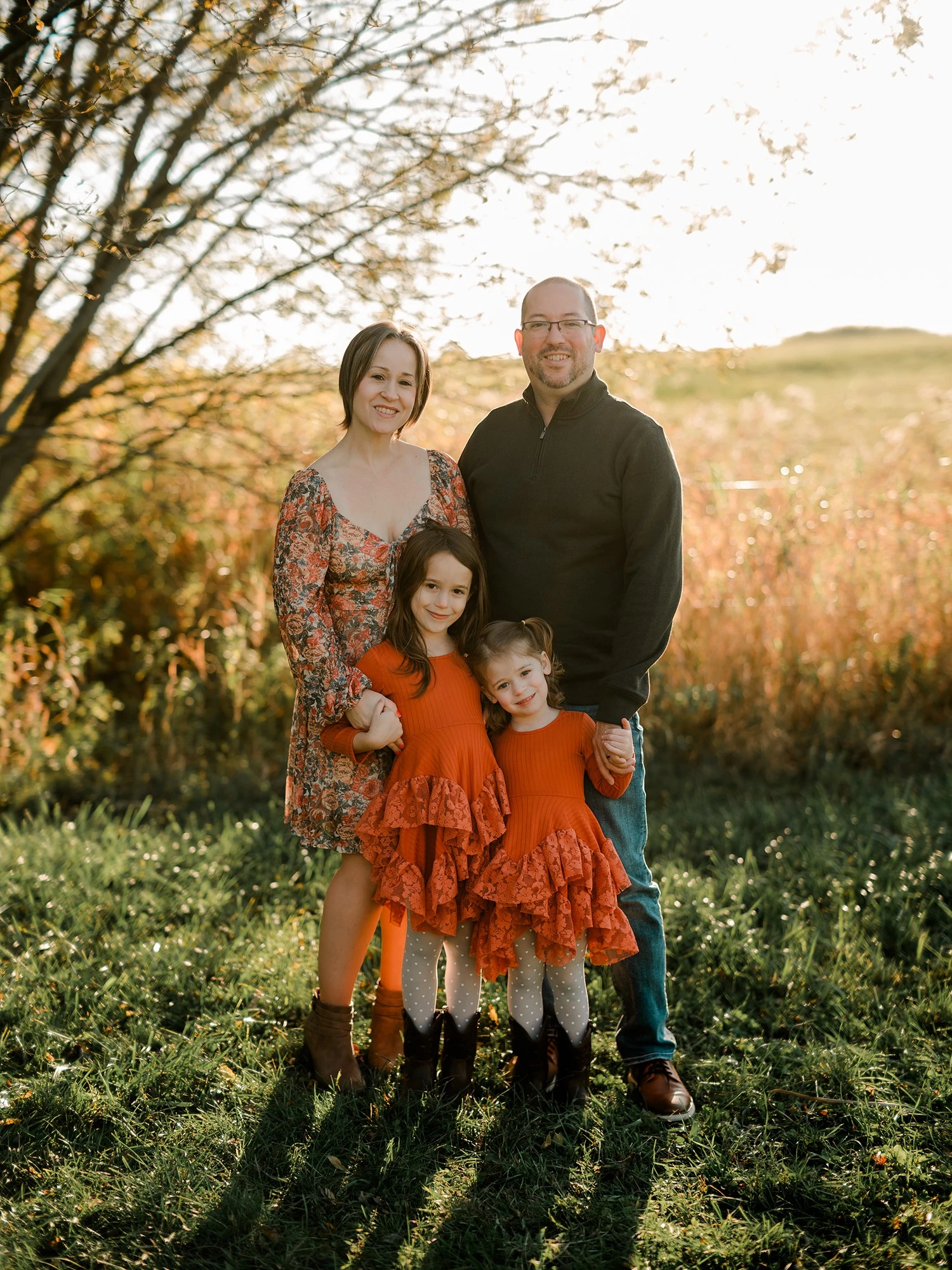
One aperture doesn’t always work for me. This is probably the one mistake I made during the beginning of my career. In order to make things easier, your aperture should be dictated by how many people are in front of you.
Here’s a quick table to help you decide the aperture depending on the number of family members in your family photography session:
| Family Members | Aperture |
| Mom and dad (2 members) | 1.8-2.2 |
| Family of 3 to 5 members | 2.8-4 |
| Larger extended family | 5.6-8 |
But why should you change the aperture depending on the number of people?
Bigger groups will require more depth of field to ensure everyone is in focus. If you’re shooting groups of people at 1.2 all the time, you are going to notice that some of the subjects are out of focus. Especially if they’re not standing on the same focal plane.
Note: The one exception would be if you’re photographing a family and only want to focus on one person.
What Camera Shutter Speed Should you Use for Family Photos?
One set shutter speed has never actually worked for me during my shoots.
Shutter speed is an ever-changing setting that will dictate how much motion is in your images. Whether it be a personal creative choice or a more technical one.
So, keeping the theme of this blog in mind, instead of asking yourself “What shutter speed should I have”, ask yourself these questions:
- Are the kids standing still?
- Are there dogs or any animals?
- Do I want to create motion for artistic images?
This is what I would generally recommend when it comes to shutter speed:
- If your family is rather calm and they’re staying in one spot, you can go to 1/250. This allows for you to bring in more light into your sensor and will still get you some very sharp results.
- As a rule of thumb, you should try and stay at 2x your focal length. So, if you’re shooting with a 50mm lens, I would not go below 1/100 or 1/125
What ISO Camera Setting Should you Use for Family Photos?
I know, I know… as photographers, we have been taught for years that you should not go past a certain point when it comes to ISO. While this is generally a good rule to follow, I believe that with today’s sensor technology, we should stop worrying about ISO as much. Most cameras perform very well at high ISOs, and if I were to choose between capturing the moment or introducing noise to an image, I would always choose the moment (for sure!).
So, crank it (if you have to).
Now that we got the major 3 settings out of the way, let’s talk about setting up your camera in a way that will make your job easier!
How to Set Up your Camera for a Family Photo Session?
Here are my notes:
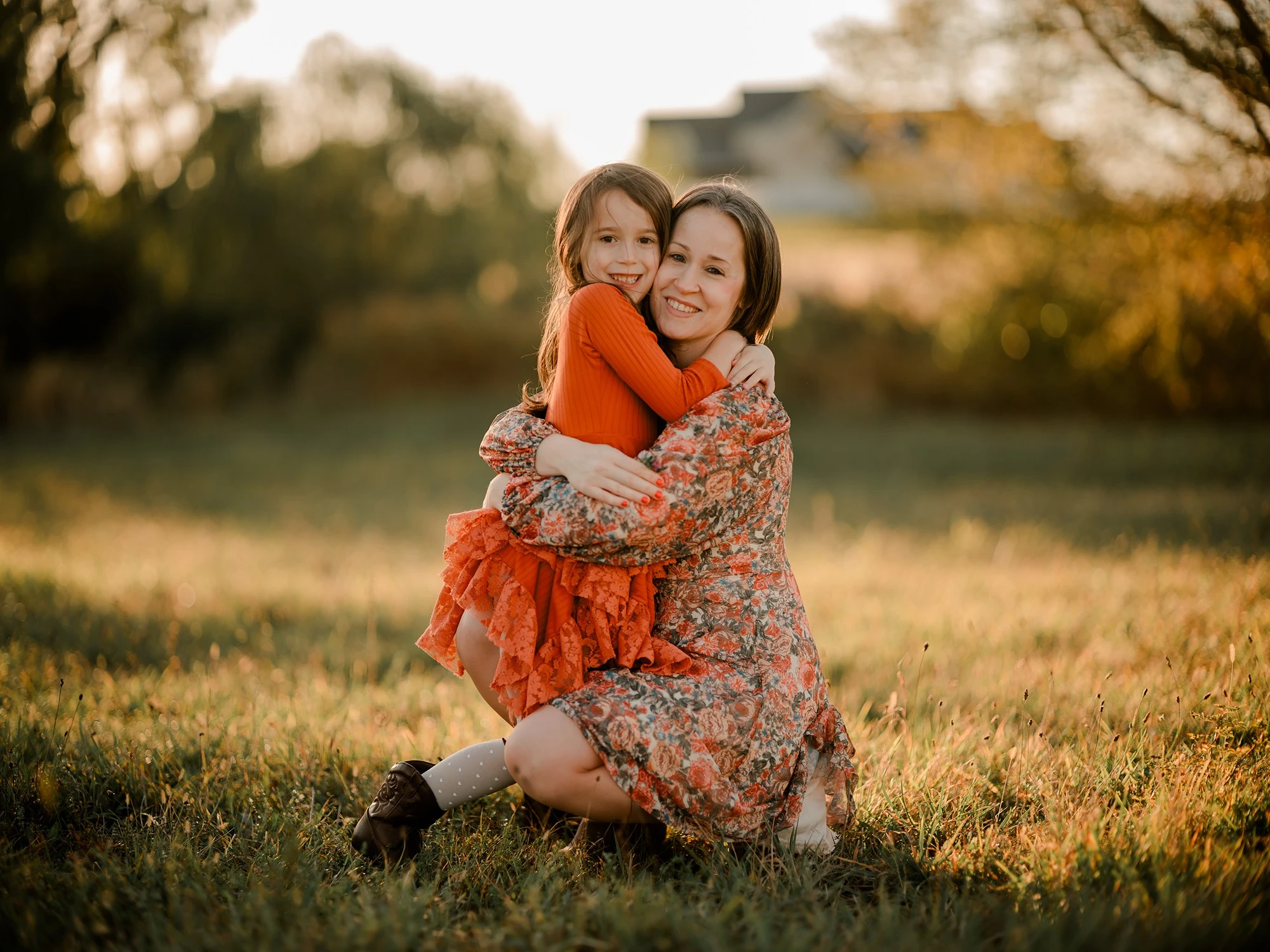
- I have always found that, when photographing families, continuous autofocus works best. Especially if there is lots of movement with children or pets.
- Depending on which camera you’re using, it might be under AF-C, Ai Servo or Continuous AF.
- Lastly, I would recommend ensuring eye AF is turned on. This will ensure that your camera finds your subject’s eyes and it will yield some tack sharp results. Pairing Continuous AF with eye AF has been one of the biggest advancements for family photographers, especially when trying to keep up with children and pets.
- Use Burst Mode! The more you shoot, the more you’ll have. Like I always say, it’s better to have it and not need it than need it and not have it. Also, kids will blink, parents will blink. So, I recommend some sort of burst mode for sure. It doesn’t have to be 30fps like some of the newest cameras have, but it can be a slow burst mode that ensures you get the best shot. So, instead of hoping for perfect timing, you can rely on a higher number of images from a single burst.
Worried about culling all the images? Well, with Aftershoot, you don’t have to worry about going through thousands of images and picking the best ones. That is now a thing of the past!
With Aftershoot, I can get home from a shoot and have it cull my images down to a manageable number at a great speed. And I absolutely love the closed eyes feature. It’s one of the best tools to sort through family sessions.
In conclusion, you can know every single setting there is to know but, you should understand that the best family photographers in the world are not so overly focused on settings. They are focused on capturing the following:
- Emotions of the session
- Interactions between the family members
- Connections they have with one another
- And the story of who they are!
So get your settings right and then focus on the things that really matter.
FAQs for Best Camera Settings for Family Photos
1. What is the best camera mode for family photos?
Aperture Priority (A/Av) mode combined with Auto ISO is the recommended starting mode for family photographers. It allows you to control the depth of field based on group size while the camera automatically manages exposure, helping you stay present with the family rather than manually adjusting settings. Once comfortable, switching to full Manual (M) mode offers complete creative control over light and motion blur.
2. What aperture should be used for large family group photos?
For large or extended family groups (6+ members), an aperture between f/5.6 and f/8 is ideal. Because family members rarely stand on a single flat focal plane, a narrower aperture provides a deeper depth of field, ensuring that individuals in the front, middle, and back rows remain tack-sharp.
3. What shutter speed is needed to photograph kids and moving families?
A minimum shutter speed of 1/250s is recommended for calm, posing families. When photographing active children, playing pets, or candid movement, increase the shutter speed to 1/500s or 1/1000s to freeze motion completely. As a baseline rule of thumb, always keep your shutter speed at least double your lens’s focal length (e.g., at least 1/160s on an 85mm lens).
4. How does autofocus help in family photography sessions?
Using Continuous Autofocus (AF-C or Ai Servo) paired with Eye AF ensures the camera tracks moving subjects across the frame continuously. Children and pets move unpredictably; Eye AF locks onto the subject’s pupil and maintains focus even as they run toward or away from the camera, drastically increasing your hit rate of sharp images.
5. How does Aftershoot handle culling for burst-mode family sessions?
Photographing families in burst mode generates hundreds of duplicate frames to catch ideal expressions. Aftershoot automates the culling process by grouping duplicate frames, detecting motion blur, and using AI facial detection to flag closed eyes and unnatural expressions. This eliminates the need to manually zoom in on every face across large group bursts, leaving you with only the best, fully focused shots.