
TL;DR: Adobe’s rising subscription costs have made Lightroom alternatives more compelling than ever. Whether you need a full AI-powered cull-edit-retouch workflow (Aftershoot), professional RAW control (Capture One), a one-time-purchase editor (DxO PhotoLab, ON1 Photo RAW), or a completely free option (Darktable), there’s a tool for every photographer. Try before you commit – most offer free trials.
Yes, Adobe Lightroom is popular. But is it still the greatest app for photo editing? We’ve uncovered the best Lightroom alternatives that are worth paying attention to.
When someone says “RAW photo editing,” the first thing that comes to mind is Adobe Lightroom.
Just like Photoshop, the famous Adobe RAW manipulation software has become an industry standard over the years.
However, as time goes by, new products and technologies emerge. Some try to mimic the giant, while others offer interesting Adobe alternatives and different approaches to RAW file editing.
Lightroom isn’t just good at editing RAW files. Many photographers also use it to:
- Organize their photos
- Cull photoshoots
- Assign metadata, and
- Upload files online
There’s a lot to take in when discussing Lightroom alternatives. But first, let’s discuss why Adobe Lightroom has become so ubiquitous.

Why is Adobe Lightroom so popular?
The most obvious reason is that it’s an Adobe product. This graphic software giant sure knows how to market and hook customers on products.
Not to say that their products are bad in any way!
On the contrary, the comprehensive approach this company has developed over the decades makes their products so attractive and easy to use. And yes, the integration between them is a nice touch.
Adobe Lightroom is a great all-in-one tool if you consider basic culling, photo management, and RAW file manipulation.
Take a look at our list of the best Lightroom presets for photographers in 2026.
When it came out back in 2007, it was quite unique and many existing rivals had to play catch-up to offer the same comprehensive set of options as Lightroom.
Think about file organization by shoots, assigning ratings to photos, filtering photos, culling shoots, assigning metadata, and syncing with cloud storage. That’s all Lightroom.
Another reason why Lightroom is so popular is its intuitive design.
Sure, there are a ton of functions and tools here, but even at first launch, things are apparent and you know where to start.
There’s a degree of familiarity if you’ve worked with Adobe products before.
But even if you’re a novice, Lightroom looks quite approachable and inoffensive. Yet it delivers a powerful set of tools to edit your RAW image files, mostly by pushing sliders around.
However, even seemingly perfect products have their flaws, and competitors will gladly line up to provide solutions to users.
For Lightroom, the primary cause for criticism over the years has been its rather bulky architecture that relies on Catalogs. They take up a lot of disk space and slow down your workflow.
There are also certain technical aspects of RAW file manipulation that critics tend to point out with Lightroom.
This is why we will review the most popular Lightroom alternatives and compare them with the famous RAW editor.
Best Lightroom Alternatives for Photo Editing
When analyzing the best Lightroom alternatives, we’ll focus on different aspects of this comprehensive tool.
Since Lightroom can function as a file manager, photo culling software, and RAW editor, the focus is quite broad.
Still, our primary interest is alternatives to the Lightroom editing workflow, so let’s look at what the market has to offer at the moment.
1. Aftershoot EDITS
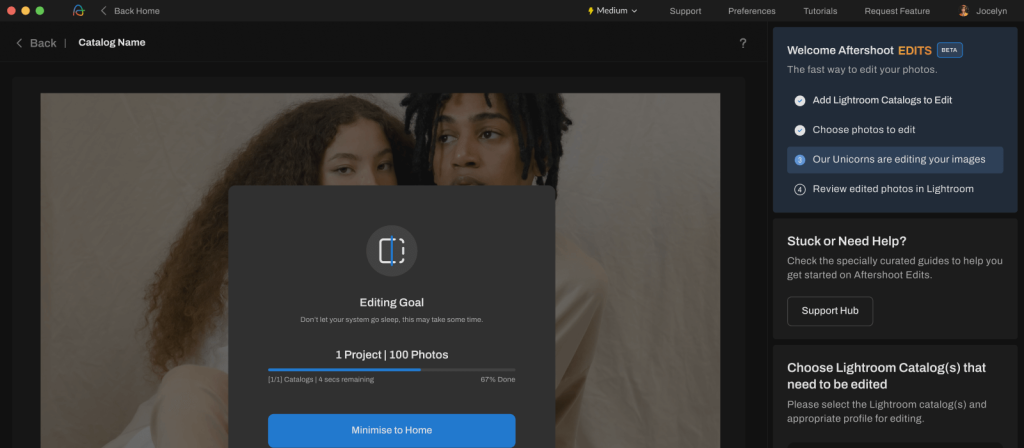
Aftershoot is one of the fastest photo culling and editing software.
Its secret is simple – Artificial Intelligence.
Aftershoot EDITS uses the power of AI to edit your RAW files automatically. It uses your existing Lightroom or Capture One catalog to analyze the style of your past edits and then replicates that style onto your unedited photos.
What would have taken you hours, if not days, can now be done within minutes!
Sure, you might still need to fine-tune some things after the automated edit. But Aftershoot EDITS gets you super close to the finished product in no time.
And the best thing is that it learns from your further manual edits and uses them for even better results next time. It sounds like the future is here, and it looks mighty impressive! Learn more about EDITS and how it works in this article.
But Aftershoot doesn’t stop at editing. AI Retouching takes the workflow further – handling skin smoothing, blemish and wrinkle removal, teeth whitening, flyaway hair, eye brightening, and AI Object Removal, all in the same app. You can batch retouch an entire album by retouching one image, then syncing those settings across hundreds of photos in seconds.
With 10 built-in presets designed for real-world shoots – weddings, portraits, newborns, headshots, and more – it’s fast, natural-looking, and fully adjustable. No pay-per-image fees, and no switching between apps.
It means you can now cull, edit, and retouch an entire shoot – all inside Aftershoot, without ever opening Photoshop.
Pros:
- AI-powered culling integrated
- Edits photos based on your personal editing style
- Batch retouch entire albums by syncing one retouched image across hundreds of photos
- Unlimited photo edits and retouches – no per-image fees
- Great metadata management
- Lightroom & Capture One catalog exports
- Very easy to use
- One flat fee
- Desktop app for macOS & Windows (no internet needed)
Cons:
- Limited manual editing tools, as it focuses more on speeding up your workflow
Aftershoot vs. Lightroom
| Software | Price | AI Editing | Works Offline |
|---|---|---|---|
| Aftershoot | 30-day free trial $24.99/mo. billed monthly $19.99/mo. billed annually | 🟢 Yes | 🟢 Yes |
| Lightroom | 7-day free trial Plans start at $14.99/mo. | 🟡 Some AI tools | 🟡 Partially |
2. Capture One Pro

The argument of Capture One vs. Lightroom never gets old. There are strong opinions in both camps to support the strengths and weaknesses of each product.
Developed by medium format camera maker Phase One, Capture One brings high-end RAW processing quality and editing options to the end user.
Just as medium format cameras can be powerful in the hands of a professional photographer yet produce mediocre photos when handled by a novice, so does Capture One.
However, when you spend enough time to familiarize yourself with the somewhat quirky and busy interface and workflow, Capture One is quite impressive.
It offers more control over how you edit each particular aspect of a photo, which is useful for professionals.
Pros:
- Advanced tool selection
- Faster and more powerful than Lightroom
- Versatile and customizable UI
- Fast and reliable tethering solutions
- Better RAW processing on the initial import
Cons:
- It can feel too technical at first
- Too professional and specific at times
- The UI isn’t as intuitive as desired
- Slow compared to AI-powered solutions
Capture One vs. Lightroom
| Software | Price | AI Editing | Works Offline |
|---|---|---|---|
| Capture One | 30-day free trial Plans start at $17/mo. | 🟡 Some AI tools | 🟡 Partially |
| Lightroom | 7-day free trial Plans start at $14.99/mo. | 🟡 Some AI tools | 🟡 Partially |
Read also: 5 Best AI Editing Software for Photographers
3. Skylum Luminar Neo

Luminar Neo by Skylum has taken the amateur photographic community by storm because it offers AI-powered editing that enhances your photos with just a few clicks. It’s a modular engine with various extensions (purchased separately) that offer far more editing options than its predecessor, Luminar AI.
There’s no need for in-depth knowledge of editing principles. You can use Templates – smart presets that auto-adjust to each image – or the Edits panel for more hands-on control.
The AI toolkit has grown considerably and now includes generative tools like GenErase, GenExpand, and GenSwap, letting you remove distractions, extend borders, and replace objects using simple text prompts.
However, if you’re a pro who’s crafted a specific style, this Adobe alternative won’t be your best pick. It sacrifices depth and precision in favor of speed and visual impact. Image management has improved but still falls short of Lightroom for large libraries.
Pros:
- AI-powered editing with generative tools (GenErase, GenExpand, GenSwap)
- Very simple to use
- It can deliver impressive results without in-depth editing knowledge
- Competitively priced with a one-time purchase option
Cons:
- Extensions for advanced features are purchased separately, adding to the cost
- Finer, style-driven edits can still be a problem for perfectionists
- No metadata editing or keyword tagging for serious library management
- Not ideal for pro photographers
Luminar Neo vs. Lightroom
| Software | Price | AI Editing | Works Offline |
|---|---|---|---|
| Luminar Neo | 7-day free trial Plans start at $99 perpetual license. | 🟢 Yes | 🟡 Partially |
| Lightroom | 7-day free trial Plans start at $14.99/mo. | 🟡 Some AI tools | 🟡 Partially |
4. Photomator
If you’re a Mac, iPhone, or iPad user looking to escape Adobe’s subscription fees, Photomator is worth serious attention. Originally developed by Pixelmator, the app was acquired by Apple in February 2025 – giving it deep integration with the Apple ecosystem and the backing of the world’s most valuable company.
Photomator is purpose-built for photo editing, making it the closest thing to a true Lightroom alternative on Apple devices.
Machine learning powers almost every area of the app – tonal adjustments, subject masking, ML Denoise, Super Resolution upscaling, and ML Match Colors for applying color grades from a reference photo. Performance on Apple Silicon is exceptionally fast, taking full advantage of the GPU and Neural Engine.
That said, it’s strictly Apple-only – no Windows or Linux support. And while its editing toolkit is impressive, it falls short of Lightroom in advanced masking precision, HDR merging, and large library management.
Think of it as Lightroom for the Apple-faithful: elegant, fast, and smart – just not a complete replacement for power users.
Pros:
- Deep Apple ecosystem integration – Mac, iPhone, iPad
- Machine learning baked into editing, masking, denoise, and upscaling
- Affordable – subscription, annual, or one-time lifetime purchase
- Confirmed to remain available and receive updates post-Apple acquisition
Cons:
- Mac/iOS only – no Windows or Linux support
- No HDR merging, panorama stitching, or multi-catalog management
- Masking precision falls short of Lightroom for complex selections
- No generative AI tools comparable to Photoshop or Luminar Neo
Photomator vs. Lightroom
| Software | Price | AI Editing | Works Offline |
| Photomator | 7-day free trial / $3.99/mo. billed monthly / $34.99/yr. billed annually / $119.99 lifetime | 🟢 Yes | 🟢 Yes |
| Lightroom | 7-day free trialPlans start at $14.99/mo. | 🟡 Some AI tools | 🟡 Partially |
5. Adobe Photoshop

Adobe Photoshop is the oldest entry on our list of Lightroom alternatives. For a very long time, it was the industry standard for photo editing, and in many ways, it still is.
Where Lightroom excels in photo management and RAW file editing, Photoshop is still unparalleled in terms of local edits, layer blending, photo manipulation, and fine portrait retouching required for professional work.
So why don’t people use it instead of Lightroom?
The reason is simple. To a great extent, Lightroom was developed to cover the shortcomings inherent to Photoshop in terms of RAW file editing and file management.
Have you ever tried working with Adobe RAW integrated into Photoshop? Yep, that’s the reason.
Not to mention that the newer spin-offs, such as Photoshop Elements and Express, offer even less functionality in favor of easier photo manipulation and fine edits. So it’s more of a complimentary package than alternatives in this case.
In May 2023, Photoshop added an exciting addition to its line-up with a new AI-powered tool called Generative Fill.
This tool allows you to add or remove items inside a photograph with simple text prompts. You simply highlight an area in a photo, click the Generate icon, type in what you want to replace your selection with, and then watch the magic happen!
Since launch, Adobe has expanded its AI toolkit considerably. Generative Expand stretches your canvas beyond the original image borders, the upgraded Remove Tool intelligently fills in deleted areas and can auto-detect distractions like wires or background people, and Generate Background replaces your subject’s backdrop with an AI-generated scene matched to the original lighting.
As of January 2026, Generative Fill now outputs at 2K resolution, doubling its previous quality ceiling.
Worth noting: all these AI features consume Adobe Firefly generative credits except for the Distraction Removal tool, and the high-resolution model uses more credits per generation – something to watch if you’re on a lower-tier plan.
Pros:
- A true classic for local editing
- Great functionality and tool selection
- Adobe Suite integration
- A vast number of third-party plugins
- Powerful and rapidly expanding AI toolkit – Generative Fill, Generative Expand, Generate Background, Remove Tool, and Generative Upscale
- AI outputs now at 2K resolution for higher-quality generative edits
- Good for post-production and retouching
Cons:
- It can feel too technical, especially to novices
- Not very good for bulk photo editing
- No catalog organization
- Generative AI features consume Firefly credits – high-resolution outputs use more credits per generation, which can be limiting on lower-tier plans
- Subscription price has increased, making it harder to justify as a Lightroom alternative on its own
Photoshop vs. Lightroom
| Software | Price | AI Editing | Works Offline |
|---|---|---|---|
| Photoshop | 7-day free trial Plans start at $22.99/mo. | 🟡 Some AI tools | 🟢 Yes |
| Lightroom | 7-day free trial Plans start at $14.99/mo. | 🟡 Some AI tools | 🟡 Partially |
6. Darktable
If you’re looking for a free Lightroom alternative that actually looks and feels like Lightroom, Darktable is as close as it gets. Open-source, completely free, and available on Windows, Mac, and Linux, it’s consistently ranked as the go-to free pick for serious photographers who don’t want to pay Adobe’s subscription fees.
Darktable is built around a non-destructive workflow with a dedicated Lighttable (library) and Darkroom (editing) module – a structure that will feel immediately familiar to Lightroom Classic users. It supports RAW files from over 400 cameras, offers a powerful masking system, parametric adjustments, and a full color calibration pipeline.
The latest version, 5.4.0 (released December 2025), adds automatic exposure compensation for Canon, Nikon, Fujifilm, Olympus, and Pentax cameras, improved Tone Equalizer controls, and a notable LUT3D processing speed boost. Unlike RawTherapee – its closest free rival – Darktable includes a proper catalog and image management system.
The learning curve, however, is steep. Darktable operates on a scene-referred color workflow that differs meaningfully from Lightroom’s approach, and the interface can feel unintuitive until you’ve invested time in it.
There’s no mobile app, no AI-powered generative tools, and community support – while active – is no substitute for professional customer service.
Pros:
- Completely free and open-source
- Lightroom-like interface with Lighttable and Darkroom modules
- Supports RAW from 400+ cameras with a full non-destructive pipeline
- Built-in catalog and library management – unlike RawTherapee
- Works on Windows, macOS & Linux
Cons:
- Steep learning curve – scene-referred workflow differs from Lightroom
- No AI-powered tools or generative editing features
- No mobile app
- Community support only – no professional customer service
- RAW files can appear flatter out of the box compared to Lightroom
Darktable vs. Lightroom
| Software | Price | AI Editing | Works Offline |
| Darktable | Free (open-source) | 🔴 No | 🟢 Yes |
| Lightroom | 7-day free trialPlans start at $14.99/mo. | 🟡 Some AI tools | 🟡 Partially |
7. ACDSee Photo Studio

Old-timers probably remember ACDSee as an alternative photo viewer and management tool rather than a photo editing product.
Yet, here we are in 2026, and ACDSee Photo Studio is in many ways closer to the Lightroom editing workflow than to its original iteration. Sure, you still get great file management and viewing functionality, but ACDSee has invested heavily in AI-powered editing tools.
The 2026 version adds AI Denoise, AI Hair Masking, and AI Develop Presets – smart, non-destructive presets that analyze and adapt to each individual photo, making batch editing considerably faster than before. It also builds on existing tools like AI Sky Replacement, AI Super-Resolution, and AI Object Selection.
What you’ll still notice about ACDSee as a Lightroom alternative is its fuss-free, no-import file management – it reads your folders live without syncing – which is a genuine advantage over Adobe’s workflow.
However, its interface remains busier than Lightroom’s, with many useful tools buried across multiple menus and modes. And while catalog management works, you’re limited to a single catalog with no option to create multiple ones – a real drawback for photographers with large, segmented libraries.
And if you compare it to today’s AI-powered tools, it’s too busy and slow.
Pros:
- All-in-one photo editing and management tool
- Growing AI toolkit – AI Denoise, AI Hair Masking, AI Develop Presets, AI Sky Replacement, and more
- No-import, folder-based file management – faster to get started than Lightroom
- Metadata management functionality
- Competitively priced with one-time perpetual license options
Cons:
- The UI needs some getting used to – tools spread across multiple menus and modes
- Only one catalog supported – no option for multiple catalogs
- Some redundant features make it feel bulky
- Develop module lacks Virtual Copies and Lightroom’s rich preset ecosystem
- Not ideal for pro photographers who need deep workflow control
ACDSee Photo Studio vs. Lightroom
| Software | Price | AI Editing | Works Offline |
|---|---|---|---|
| ACDSee Photo Studio | One-time-fee packages ranging from $99.99/year to $209 | 🟡 Some AI tools | 🔴 No |
| Lightroom | 7-day free trial Plans start at $14.99/mo. | 🟡 Some AI tools | 🟡 Partially |
8. ON1 Photo RAW

As far as comprehensive packages go, ON1 Photo RAW is a decent option to consider.
It’s an all-in-one photo tool that lets you import, manage, cull, edit globally and locally, export, and publish photos – making it one of the more complete Lightroom replacements available.
The AI toolkit has grown considerably. The Super Select AI tool lets you make precise adjustments to specific details in your photo, while Sky Replacement remains one of the most impressive implementations we’ve seen.
Newer additions include Generative Erase (removes distractions with AI-generated fill), Generative Crop (expands image borders intelligently), and Depth Masking for distance-based adjustments. ON1 Photo RAW 2026 also brings noticeably faster performance across the board.
The downside? Precise, style-driven fine-tuning still requires hands-on manual work rather than fully automated edits. But as a Lightroom alternative, ON1 Photo RAW remains a compelling offering.
Pros:
- A great all-in-one editing tool
- Expanding generative AI toolkit – Generative Erase, Generative Crop, Super Select AI
- One-time purchase – no subscription required
Cons:
- Precise, style-driven edits still require manual work
- Photo management lacks Lightroom’s depth for very large libraries
- MAX version with plugin support costs extra
ON1 Photo RAW vs. Lightroom
| Software | Price | AI Editing | Works Offline |
|---|---|---|---|
| ON1 Photo RAW | 30-day free trial $99.99 once-off | 🟡 Some AI tools | 🔴 No |
| Lightroom | 7-day free trial Plans start at $14.99/mo. | 🟡 Some AI tools | 🟡 Partially |
9. DxO PhotoLab

If you haven’t heard of DxO Mark, you probably haven’t been geeking out about camera gear much. It is one of the most reliable camera and lens testing, rating, and calibration resources.
Their testing technique consists of shooting thousands of images with each particular camera body and camera lens – and their combinations – using various test scenes under different lighting conditions.
But aren’t we talking about RAW files and the best Lightroom alternatives?
Well, this is where DxO PhotoLab comes in. It’s a comprehensive RAW editing tool that uses the technical database DxO Mark has accumulated over the years to enhance your photos in relation to the gear you’ve used to take the shot.
And yes, the results are impressive.
In many ways, it offers functionality similar to a Lightroom editing workflow. But what sets DxO PhotoLab apart is its proprietary AI engine – DeepPRIME XD2s – which handles noise reduction and detail recovery at a level that outperforms almost every other tool on the market.
New tools like Hue Masks for color-based local adjustments and an updated Tone Curve with a Luma channel make it an even more capable editing suite. The May 2025 update (v8.5) pushed things further still, with DeepPRIME 3 support added for Fujifilm X-Trans sensors.
The downside? Photo management remains basic compared to Lightroom, and DeepPRIME processing can be slow on older machines.
Pros:
- Best-in-class AI noise reduction via DeepPRIME XD2s and DeepPRIME 3
- Lens and camera-specific corrections based on DxO’s optical testing database
- In-depth RAW manipulation with Hue Masks, Tone Curve, and U-Point local adjustments
- One-time purchase – no subscription required
Cons:
- Photo management and library organization is limited compared to Lightroom
- DeepPRIME processing is hardware-intensive and slow on older machines
- No generative AI tools for object removal or scene manipulation
- Steeper learning curve for photographers new to DxO’s workflow
DxO PhotoLab vs. Lightroom
| Software | Price | AI Editing | Works Offline |
|---|---|---|---|
| DxO PhotoLab | 30-day free trial $239.99 once-off / upgrade pricing available | 🟢 Yes | 🟢 Yes |
| Lightroom | 7-day free trial Plans start at $14.99/mo. | 🟡 Some AI tools | 🟡 Partially |
Our recommendations
Whether you’re looking for fast AI-powered bulk editing of large batches or overly technical manipulation of every single photo, there is a product for you.
So what should you try if you’re looking for the best Lightroom alternatives?
If you’re like most photographers where time is limited, you’ll want to consider the speed of your editing workflow and good file management capabilities.
This makes Aftershoot EDITS the clear winner.
It’s simple to use and drastically reduces your editing time, but it won’t completely replace Lightroom – you’ll still need it (or Capture One) when uploading your edited images to train your AI Profile.
You can learn more about creating your AI Profile in Aftershoot EDITS here.
Aftershoot EDITS offers a massive improvement to your workflow without requiring much of a learning curve.
The fact that Aftershoot allows you to cull and edit photos in 1 app within just a few clicks is amazing.
You can save hundreds of hours annually, which is huge when you’re a small business owner.
In 2025, Aftershoot launched AI Retouching – bringing one-click portrait retouching, batch skin smoothing, and selective subject retouching directly into the platform. The 2026 roadmap takes it even further, with a built-in RAW editor, self-improving AI profiles that learn from your adjustments, AI denoising, object removal, and advanced masking all coming this year. A complete cull → edit → retouch → deliver workflow, all in one app.
If AI isn’t your thing, then using a tool with more technical editing options, such as Capture One, is a good option.
It’s a powerful tool that will cater to professionals that need the highest level of control over a broad range of image characteristics. It won’t be as fast as AI editing, but it will give you more control for now.
Honestly, the best option for your workflow may be a combination of both; using AI editing to get you 95% of the way there and then doing final retouches in another platform certainly gives you the best of both worlds.
Whether it’s photography, craft beer brewing, extended range guitars, or science fiction novels, Kirill switches between his passions like a vane during a Category 4 hurricane. But once he hones in on a topic, he becomes laser-focused, verging on obsessive, until the task is tackled and a well-deserved IPA is savored after a hard day’s work.